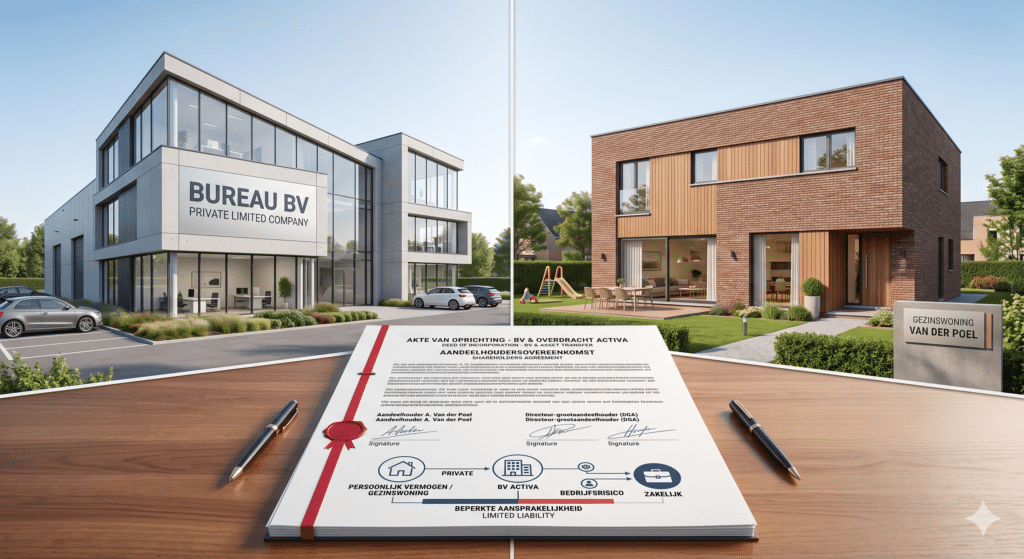
A high-net-worth divorce in the Netherlands follows the same rules as any divorce, but three questions decide the financial outcome: which matrimonial property regime applies, what the business, real estate and pension rights are worth, and which country’s law governs the division. Your wedding date and any prenuptial agreement (huwelijkse voorwaarden) decide which assets are shared; for an international couple married on or after 29 January 2019, Regulation (EU) 2016/1103 decides which law applies to the property.
Innholdsfortegnelse
Which matrimonial property regime applies?
That depends on when you married and whether you made a prenuptial agreement. Without a prenuptial agreement, couples married before 1 January 2018 are in a full community of property (algehele gemeenschap van goederen); couples married on or after that date are in a begrenset formuefellesskap (beperkte gemeenschap van goederen).
What falls into the limited community?
Under Article 1:94 of the Dutch Civil Code (BW), the community includes everything the spouses acquire during the marriage and what they already owned jointly before it. Assets each spouse owned alone before the marriage stay private, and inheritances and gifts are excluded by law.
The exclusion only holds as far as you can trace the asset. That is why documentation of what existed before the wedding, and how it was reinvested, is often the core of the dispute. Pension rights covered by the Pension Rights Equalisation (Divorce) Act (WVPS) are also outside the community and are dealt with separately (Article 1:94(2)(b) BW).
What changes with a full community?
Under the regime before 2018, everything either spouse owned became joint property, including pre-marital assets, unless an inheritance or gift came with an exclusion clause (uitsluitingsclausule). For couples with substantial inherited wealth or long-held business interests, tracing that exclusion clause is decisive.
What does a prenuptial agreement change?
A prenuptial agreement can exclude all community, or set a periodic or final settlement clause (verrekenbeding). Business growth during the marriage is often contested under such a clause. Have a specialist review the actual wording before assuming it protects your business.
What happens to a business held through a BV?
If the BV shares belong to the community or fall under a settlement clause, they are valued and the value is divided. The business-owning spouse usually keeps the shares and pays out the other spouse in cash or with other assets.
For a director and major shareholder (directeur-grootaandeelhouder, DGA), the questions overlap:
- Do the shares fall into the community or under a settlement clause?
- Which valuation method applies, for example discounted cash flow or net asset value?
- Do assets or debts within the BV affect the value?
- Do shareholder agreements or articles of association restrict a transfer of the shares?
- Can the BV pay out without endangering its solvency?
An independent business valuator is usually engaged, and that report becomes the financial core of the case. We work with the firm’s corporate lawyers on the same file, because valuation and property law cannot be answered separately.
How are real estate and investment portfolios divided?
Each property is valued by a certified valuer (taxateur), the mortgage debt is allocated, and one spouse either takes it over against payment or it is sold. A notary records the transfer of real estate in a deed.
For investment portfolios, the central question is whether gains built up during the marriage are joint, or can be traced back to excluded pre-marital assets or inheritances. Full transaction histories are often needed.
Hvordan er pensjonsrettighetene fordelt?
Under the Pension Rights Equalisation (Divorce) Act (Wet verevening pensioenrechten bij scheiding, WVPS), each spouse is entitled to half of the old-age pension the other built up during the marriage, unless you excluded or changed this in a prenuptial agreement or a written divorce agreement (Article 2(1) WVPS).
The pension provider pays the equalised share directly to the former spouse only if one of you notifies it on the official form within two years after the divorce (Article 2(2) WVPS). After that period, you have to settle the payment between yourselves. Instead of equalisation, you can agree on conversion into an independent pension right.
A bill to replace equalisation with conversion as the default (Wet pensioenverdeling bij scheiding 2022) is pending and not in force, so the WVPS applies to divorces now. A DGA’s pension built up within the company before 2017 also falls under equalisation, but paying it out from the BV raises solvency questions that a regular pension fund does not face.
Which court and which law apply in an international divorce?
Each question has its own set of rules, and they can point to different countries. Check all of them at the start.
Hvilken domstol har jurisdiksjon?
Within the EU, Regulation (EU) 2019/1111 (Brussels II-ter), applicable since 1 August 2022, decides which court can hear the divorce, usually based on habitual residence. It also governs recognition of divorce judgments and decisions on parental responsibility between EU member states.
Which law governs the divorce itself?
A Dutch court decides under Dutch law whether the marriage can be dissolved (Article 10:56 BW). The Netherlands does not apply the Rome III Regulation; only spouses with a common foreign nationality can, under conditions, choose the law of that country.
Which law governs the property?
For spouses married on or after 29 January 2019, Regulation (EU) 2016/1103 determines the law that applies to the matrimonial property regime. For earlier marriages, older conflict-of-law rules apply, which can lead to a different result. The applicable property law can differ from the law that governs the divorce.
What if assets are in several countries?
A Dutch judgment does not reach every foreign asset by itself. Recognition or enforcement abroad may be needed, and the order in which claims are brought can matter. If your spouse cannot be found, Dutch law has its own route for a skilsmisse fra en fraværende ektefelle.
If children have lived in several countries, the 1996 Hague Child Protection Convention and, in case of a wrongful move, the 1980 Hague Child Abduction Convention apply alongside Brussels II-ter.
How is partner maintenance determined?
Partner maintenance (partneralimentatie) depends on the need of the recipient and the capacity to pay of the other spouse. The judges’ guidelines (Tremanormen) give the method, but in high-income cases the court looks closely at the standard of living during the marriage.
Without a court-set term, the obligation ends after half the length of the marriage, with a maximum of five years (Article 1:157(1) BW). Exceptions apply: after a marriage of more than 15 years where the recipient is within ten years of state pension age, and until the youngest child of the marriage turns 12 (Article 1:157(2)-(4) BW). Disputes in high-asset cases usually concern investment returns as income, income from a BV that is retained rather than paid out, and the interplay between maintenance and the asset division. For maintenance for children, see our barnebidrag artikkel.
What should you check at the start?
- Your wedding date, the place of marriage and any prenuptial agreement or later notarial changes.
- Evidence of assets owned before the marriage, inheritances and gifts, including exclusion clauses.
- BV annual accounts, shareholder agreements and the DGA’s pension arrangements.
- Valuations and mortgage documents for every property.
- Pension statements, and the two-year deadline for notifying the pension provider.
- Assets, accounts and habitual residence in other countries.
What can we do for you with a high-net-worth divorce?
Våre familieadvokater work with our corporate lawyers on divorces involving businesses and international assets. See also our skilsmisseadvokat page and our article on the cost of a divorce.
- We determine which matrimonial property regime and which law apply to your assets.
- We review the scope of your prenuptial agreement and any settlement clause.
- We instruct and assess a business valuation of the BV shares.
- We draw up the division proposal for real estate, portfolios and pension rights.
- We calculate partner maintenance in complex income structures.
- We file the divorce petition and conduct proceedings, or negotiate a settlement.
Sammendrag
- Your wedding date and prenuptial agreement decide whether there is a full, limited or no community of property.
- In a limited community, pre-marital assets, inheritances and gifts stay private, if you can trace them (Article 1:94 BW).
- BV shares in the community are valued and settled, usually by a payout.
- Pensions are equalised under the WVPS; notify the provider within two years.
- In international cases, jurisdiction, divorce law and property law are separate questions with separate rules.
Ofte stilte spørsmål
Does the 2018 change in matrimonial property law affect couples married before 2018?
No. Couples married before 1 January 2018 without a prenuptial agreement remain in the full community of property, unless they changed their regime by notarial deed.
Hva skjer med bedriften min ved en nederlandsk skilsmisse?
If the BV shares fall into the community or under a settlement clause, they are valued and half of the relevant value is settled, usually by a payout in cash or other assets. A prenuptial agreement can change this.
Does Rome III apply to a divorce in the Netherlands?
No. The Netherlands does not participate in Rome III. A Dutch court applies Dutch law to the divorce itself (Article 10:56 BW), with a limited choice for spouses with a common foreign nationality.
Hvor lenge varer partnervedlikehold?
Without a court-set term, half the length of the marriage with a maximum of five years (Article 1:157 BW), with longer terms for marriages over 15 years close to state pension age and until the youngest child turns 12.